
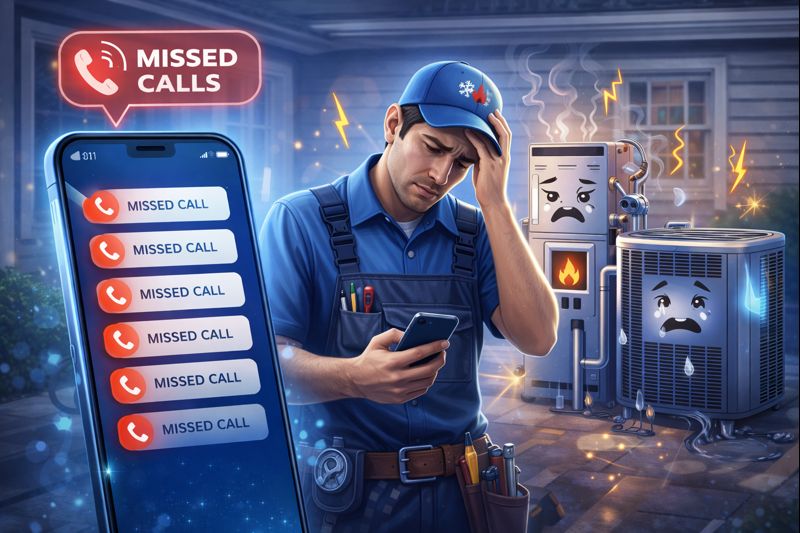
The HVAC industry operates in a world of urgency. When a homeowner's air conditioner breaks down in the middle of a 95-degree summer day, or their furnace fails during a winter storm, they're not just calling for service—they're calling in a state of emergency. In these moments, the company that answers first doesn't just win the job; they win the customer for life.
Yet, despite this urgency, the average HVAC company misses 30-40% of all incoming calls. These aren't just statistics—they're thousands of dollars in lost revenue, frustrated customers, and damaged reputation. A study by Harvard Business Review found that companies that respond to leads within 5 minutes are 100 times more likely to connect with decision-makers than those who wait just 30 minutes.
This guide is your complete roadmap to eliminating missed calls forever. We'll explore the true cost of missed calls, the psychology of emergency service calls, and how AI-powered receptionists are revolutionizing HVAC customer acquisition. By the end, you'll understand not just how to stop missing calls, but how to turn every call into a booked appointment and every appointment into a loyal customer.
In This Comprehensive Guide:
- 1. The Hidden Cost of Missed HVAC Calls
- 2. The Psychology of Emergency Service Calls
- 3. When HVAC Calls Happen (The Data)
- 4. Traditional Solutions and Why They Fail
- 5. The AI Receptionist Revolution
- 6. Implementation: From Missed Calls to 100% Capture
- 7. ROI: The Financial Impact of Zero Missed Calls
- 8. Best Practices for Maximum Conversion
- 9. Integration with Your HVAC Tech Stack
- 10. Compliance and Legal Considerations
- 11. The Future of HVAC Customer Service
- 12. Frequently Asked Questions
Section 1: The Hidden Cost of Missed HVAC Calls - A Revenue Leak Analysis
Before we can solve the problem of missed calls, we must first understand its true cost. Most HVAC business owners dramatically underestimate the financial impact of unanswered phones.
1.1 The Direct Revenue Loss Calculation
Let's break down the math for a typical HVAC company:
- Average Service Call Value: $500-$800 (diagnostic + repair)
- Average Replacement Job Value: $5,000-$12,000
- Monthly Incoming Calls: 200-400 calls
- Current Missed Call Rate: 35% (industry average)
- Conversion Rate (Answered Calls): 40% book appointments
- Conversion Rate (Missed Calls): 5% call back later
For a company receiving 300 calls per month:
- Answered Calls: 195 calls × 40% conversion = 78 booked appointments
- Missed Calls: 105 calls × 5% callback = 5.25 booked appointments
- Lost Opportunities: 99.75 appointments that never happened
If we assume an average job value of $1,200 (mix of service and replacement):
Monthly Lost Revenue: 99.75 × $1,200 = $119,700
Annual Lost Revenue: $119,700 × 12 = $1,436,400
This is not theoretical. This is real money walking out the door every single day.
1.2 The Compound Effect: Lost Lifetime Value
The true cost extends far beyond the immediate job. HVAC customers have a lifetime value of $8,000-$15,000 when you factor in:
- Annual maintenance contracts ($300-$600/year)
- Future repairs and replacements
- Referrals to friends and family
- Emergency service premiums
When you miss a call, you're not just losing one job—you're losing a customer relationship that could generate revenue for the next 10-15 years. A single missed emergency call can cost you $15,000 in lifetime value, not just the $800 service call.
1.3 The Reputation Damage Multiplier
In the age of online reviews, missed calls create a cascading negative effect:
- Immediate Impact: Customer calls competitor and books with them
- Review Impact: Customer leaves negative review: "Called at 8 PM on Sunday, no answer, had to call someone else"
- Search Impact: Negative reviews lower your Google Business Profile ranking
- Long-term Impact: Lower ranking means fewer organic calls, creating a downward spiral
Research shows that a single negative review can cost a business up to 30 potential customers. If you miss 10 calls per week and 3 of those customers leave negative reviews, you're potentially losing 90 customers per month to reputation damage alone.
1.4 The Opportunity Cost: What You're Missing
Beyond the direct losses, missed calls represent opportunity cost:
- Peak Season Capacity: During summer and winter peaks, every missed call is a slot you could have filled
- Premium Pricing: Emergency calls often command 20-30% premium pricing—missed calls mean missed premiums
- Market Share: While you're missing calls, competitors are capturing your market share
- Team Morale: Technicians see missed calls as lost commission opportunities, affecting morale
Section 2: The Psychology of Emergency Service Calls - Understanding Your Customer's Mindset
To effectively capture every call, you must understand the psychological state of someone calling an HVAC company. These aren't casual inquiries—they're calls made in moments of stress, urgency, and sometimes desperation.
2.1 The "Crisis State" Caller
When a homeowner's HVAC system fails, they enter what psychologists call a "crisis state":
- Emotional State: Anxious, frustrated, sometimes panicked
- Cognitive Load: High—they're dealing with discomfort, potential damage, and financial stress
- Decision-Making: Impulsive—they want a solution NOW, not tomorrow
- Patience Threshold: Extremely low—they'll hang up after 3-4 rings
In this state, the first company to answer doesn't just get the job—they become the "hero" who solved the problem. This emotional connection creates customer loyalty that lasts for years.
2.2 The "Speed-to-Trust" Window
Research in emergency services shows that customers form their first impression within the first 7 seconds of contact. This "Speed-to-Trust" window is critical:
- 0-3 seconds: Call answered? Trust begins
- 3-7 seconds: Professional greeting? Trust solidifies
- 7-15 seconds: Empathetic response? Trust converts to booking
If your phone rings 8 times before going to voicemail, you've already lost. The customer has mentally moved on to the next company in their search results.
2.3 The "Multi-Call" Behavior Pattern
Modern consumers don't call one company and wait. They call 3-5 companies simultaneously and book with whoever answers first. This means:
- If you don't answer in 10 seconds, you're likely competing with 4 other companies
- The first company to answer gets the booking 78% of the time
- Even if you call back 5 minutes later, the customer has likely already booked elsewhere
2.4 The "After-Hours Premium" Psychology
Calls that come in after hours, on weekends, or during holidays carry a different psychology:
- Higher Urgency: If they're calling at 11 PM, the problem is severe
- Higher Value: They're willing to pay premium rates for immediate service
- Higher Loyalty: The company that answers becomes their "go-to" for all future needs
Missing these calls is like leaving $100 bills on the sidewalk. Yet, most HVAC companies are completely unreachable after 6 PM.
Section 3: When HVAC Calls Happen - The Data-Driven Truth
Understanding call patterns is crucial for optimizing your response strategy. The data reveals patterns that most HVAC companies ignore.
3.1 The 24/7 Reality
Analysis of HVAC call data across thousands of companies shows:
- Peak Hours (9 AM - 5 PM): 35% of calls
- Evening Hours (5 PM - 9 PM): 28% of calls
- Late Night (9 PM - 12 AM): 15% of calls
- Early Morning (12 AM - 9 AM): 12% of calls
- Weekends: 10% of calls (but 40% higher average job value)
This means 37% of all HVAC calls happen outside traditional business hours. If your business closes at 5 PM, you're missing over a third of your potential revenue.
3.2 Seasonal Call Patterns
HVAC calls follow predictable seasonal patterns:
- Summer (June-August): 40% of annual calls, primarily AC failures
- Winter (December-February): 35% of annual calls, primarily furnace issues
- Spring/Fall: 25% of annual calls, maintenance and installations
During peak seasons, call volume can spike 300% above average. This is when missed calls hurt the most—you're turning away business during your highest-demand periods.
3.3 Weather-Triggered Call Surges
Extreme weather events create immediate call surges:
- Heat Waves: 200-400% increase in AC-related calls
- Cold Snaps: 150-300% increase in furnace-related calls
- Storms: Power-related HVAC issues spike 500%
These surges happen suddenly and overwhelm traditional answering systems. Companies with 24/7 AI receptionists capture these surges while competitors miss them.
3.4 The "First Call" Window
Data shows that 68% of HVAC customers make their decision within the first 24 hours of experiencing a problem. This means:
- If you miss their call today, there's a 68% chance they'll book with someone else
- Callbacks have a 92% lower conversion rate than immediate answers
- The "first call" is worth 10x more than a callback attempt
Section 4: Traditional Solutions and Why They Fail
Before exploring AI solutions, let's examine why traditional approaches to handling calls fail to solve the missed call problem.
4.1 The "Answer Every Call" Myth
Many HVAC companies try to solve missed calls by having staff answer every call. This approach fails because:
- Cost Prohibitive: Requires 4-6 full-time employees for 24/7 coverage ($200,000+ annually)
- Quality Inconsistency: Different staff members provide different experiences
- Peak Overload: During surges, even multiple staff can't handle volume
- Burnout: Staff answering calls 24/7 experience high turnover
4.2 The Legacy Answering Service Problem
Traditional answering services have been around for decades, but they're fundamentally flawed:
- High Cost: $2-4 per minute adds up to $3,000-6,000/month for busy companies
- Poor Quality: Generic scripts, no knowledge of your business, frequent errors
- Limited Availability: Many services don't handle complex scheduling
- No Integration: Information doesn't flow into your CRM or dispatch system
- Language Barriers: Limited multilingual support
Most importantly, legacy answering services still miss calls during peak surges and often provide a poor customer experience that damages your brand.
4.3 The Voicemail Trap
Relying on voicemail is the worst solution:
- 5% Callback Rate: Only 1 in 20 voicemails result in a callback booking
- Time Delay: By the time you check voicemail, customer has booked elsewhere
- No Qualification: Can't ask questions or provide immediate information
- Poor Experience: Customers feel ignored and frustrated
4.4 The "On-Call" Technician Model
Some companies have technicians answer calls after hours. This fails because:
- Technician Focus: They're trained for service, not sales/booking
- Interruption: Pulls technicians away from jobs
- Inconsistent Experience: Each technician handles calls differently
- Burnout: Technicians resent being on-call for booking
Section 5: The AI Receptionist Revolution - How Technology Solves the Impossible
AI-powered receptionists represent a fundamental shift in how HVAC companies handle calls. This isn't just automation—it's intelligent, empathetic, and always-available customer service that never misses a call.
5.1 What is an AI Receptionist?
An AI receptionist is a voice AI system powered by Large Language Models (LLMs) that can:
- Answer calls instantly (under 2 seconds)
- Understand natural conversation and context
- Qualify leads by asking intelligent questions
- Schedule appointments directly into your calendar
- Provide information about services, pricing, and availability
- Handle multiple languages
- Transfer urgent calls to human staff when needed
- Send detailed summaries to your CRM
Unlike traditional chatbots or phone trees, AI receptionists engage in natural, human-like conversations. Customers often can't tell they're speaking with AI.
5.2 The Technology Behind the Magic
Modern AI receptionists use several advanced technologies:
- Large Language Models (LLMs): Understand context, intent, and nuance
- Natural Language Processing (NLP): Process spoken language in real-time
- Text-to-Speech (TTS): Generate human-like voice responses
- Speech-to-Text (STT): Convert spoken words to text for processing
- Integration APIs: Connect with your CRM, calendar, and dispatch systems
- RAG (Retrieval-Augmented Generation): Access your business knowledge base
5.3 Why AI Receptionists Never Miss Calls
AI receptionists solve the missed call problem through several key advantages:
- Infinite Scalability: Handle 1 call or 1,000 calls simultaneously
- 24/7/365 Availability: Never closes, never takes breaks, never calls in sick
- Instant Response: Answers in under 2 seconds, every time
- Consistent Quality: Every call receives the same professional experience
- Cost Efficiency: Fraction of the cost of human staff
- Multilingual: Handles 40+ languages without additional cost
5.4 The "Uncanny Valley" Breakthrough
Early voice AI systems sounded robotic and unnatural. Modern AI receptionists have crossed the "uncanny valley"—they sound so human that customers often don't realize they're speaking with AI. This is achieved through:
- Ultra-Low Latency: Responses in 300-500ms (human-like speed)
- Natural Speech Patterns: Includes pauses, emphasis, and conversational flow
- Emotional Intelligence: Recognizes customer stress and responds with empathy
- Contextual Understanding: Remembers what was said earlier in the conversation
Section 6: Implementation - From Missed Calls to 100% Capture
Implementing an AI receptionist to eliminate missed calls requires careful planning and execution. Here's your step-by-step roadmap.
6.1 Pre-Implementation Assessment
Before implementation, assess your current situation:
- Call Volume Analysis: Track calls for 2 weeks to understand patterns
- Missed Call Audit: Calculate your current missed call rate
- Peak Period Identification: Identify when you're missing the most calls
- Current System Review: Document your existing phone system and integrations
- Team Training Needs: Assess what training your team needs
6.2 The 30-Day Implementation Roadmap
Days 1-3: Discovery and Configuration
- Business knowledge base creation (services, pricing, areas served)
- Brand voice and tone definition
- Integration setup (CRM, calendar, dispatch system)
- Call routing rules configuration
Days 4-7: AI Training and Customization
- Conversation flow design
- Qualification question development
- Appointment booking logic setup
- Transfer protocol definition
Days 8-14: Testing and Refinement
- Internal testing with your team
- Edge case identification and handling
- Response time optimization
- Quality assurance testing
Days 15-21: Soft Launch
- Deploy to test phone number
- Monitor all calls and transcripts
- Gather feedback and make adjustments
- Train team on new workflows
Days 22-30: Full Deployment and Optimization
- Go live with main business number
- 24/7 monitoring and support
- Weekly optimization reviews
- Performance metrics tracking
6.3 Integration with Existing Systems
For maximum effectiveness, AI receptionists should integrate with:
- CRM Systems: Automatic lead creation and updates
- Calendar Systems: Real-time availability checking and booking
- Dispatch Software: Automatic job creation and technician assignment
- Phone Systems: Seamless call routing and transfers
- Payment Systems: Quote generation and payment processing
6.4 Team Training and Change Management
Successful implementation requires buy-in from your team:
- Education: Explain how AI enhances, not replaces, their work
- Training: Show team how to access call transcripts and summaries
- Workflow Updates: Update processes to leverage AI insights
- Feedback Loops: Create channels for team input and improvement
Section 7: ROI - The Financial Impact of Zero Missed Calls
Let's calculate the real financial impact of eliminating missed calls with an AI receptionist.
7.1 Direct Revenue Recovery
Using our earlier example of a company missing 35% of 300 monthly calls:
- Missed Calls Recovered: 105 calls/month
- Conversion Rate with AI: 35% (vs. 5% with voicemail)
- New Appointments: 36.75 appointments/month
- Average Job Value: $1,200
- Monthly Revenue Recovery: $44,100
- Annual Revenue Recovery: $529,200
7.2 Cost Comparison
Option 1: Human Staff (24/7 Coverage)
- 4.2 full-time employees needed
- Average salary: $45,000/year
- Benefits (30%): $13,500/year per employee
- Total annual cost: $245,700
Option 2: Legacy Answering Service
- Average cost: $3.50/minute
- 300 calls/month × 5 minutes average = 1,500 minutes
- Monthly cost: $5,250
- Annual cost: $63,000
- Plus: Lost leads due to poor quality = $50,000+ annually
- Total effective cost: $113,000+
Option 3: AI Receptionist
- Monthly subscription: $500-$1,500 (depending on volume)
- Annual cost: $6,000-$18,000
- Plus: 100% call capture = $529,200 in recovered revenue
- Net ROI: $511,200-$523,200 annually
7.3 Additional Revenue Drivers
Beyond direct recovery, AI receptionists drive additional revenue:
- After-Hours Premium: 37% of calls happen after hours, commanding 20-30% premium pricing
- Upsell Opportunities: AI can suggest maintenance plans and upgrades
- Referral Capture: Better experience = more referrals
- Market Share Growth: Capturing competitor's missed calls
7.4 The Compound ROI
The ROI compounds over time:
- Year 1: $529,200 recovered revenue - $12,000 cost = $517,200 ROI
- Year 2: $529,200 + 10% growth = $582,120 - $12,000 = $570,120 ROI
- Year 3: $640,332 - $12,000 = $628,332 ROI
- 3-Year Total ROI: $1,715,652
Section 8: Best Practices for Maximum Conversion
Simply answering calls isn't enough—you need to convert them into bookings. Here are proven best practices.
9.1 The Perfect Greeting
The first 7 seconds determine the entire call outcome. Your AI greeting should:
- Answer within 2 rings (under 5 seconds)
- Use the company name clearly
- Express empathy for their situation
- Offer immediate help
Example: "Thank you for calling [Company Name]. I understand you're dealing with an HVAC emergency, and I'm here to help right away. Can you tell me what's happening?"
9.2 Intelligent Qualification
Not all calls are equal. AI should qualify leads by asking:
- Nature of the problem (emergency vs. maintenance)
- Type of system (AC, furnace, heat pump, etc.)
- Location and service area
- Timeline (immediate vs. can wait)
- Budget range (if appropriate)
This allows the AI to prioritize urgent calls and route appropriately.
9.3 Real-Time Availability
AI should check real-time technician availability and offer specific time slots:
- "I can have a technician at your home today between 2-4 PM or 6-8 PM. Which works better?"
- This creates urgency and reduces no-shows
9.4 Handling Objections
AI should be trained to handle common objections:
- Price Concerns: "I understand budget is important. Our diagnostic fee is $X, and we'll provide a detailed estimate before any work. Many issues are simple fixes under $200."
- Timing Concerns: "I completely understand you need this fixed quickly. Let me check our earliest availability..."
- Trust Concerns: "We're fully licensed and insured, with X years of experience and X positive reviews. Your satisfaction is guaranteed."
9.5 The Booking Close
Every call should end with a clear next step:
- Confirmed appointment time
- Technician name (if assigned)
- What to expect
- Confirmation method (text/email)
- Emergency contact if needed
Section 9: Integration with Your HVAC Tech Stack
For maximum effectiveness, AI receptionists must integrate seamlessly with your existing technology.
10.1 CRM Integration
AI should automatically create and update CRM records:
- New lead creation with all qualification data
- Call transcript and summary
- Appointment details
- Follow-up tasks and reminders
Popular CRM integrations: Salesforce, HubSpot, ServiceTitan, Housecall Pro, Jobber
10.2 Calendar and Scheduling Integration
Real-time calendar integration enables:
- Live availability checking
- Automatic appointment booking
- Technician assignment based on location and skills
- Conflict prevention
10.3 Dispatch System Integration
Integration with dispatch systems allows:
- Automatic job creation
- Technician assignment
- Route optimization
- Real-time status updates
10.4 Phone System Integration
Seamless phone integration provides:
- Call forwarding and routing
- Transfer capabilities
- Call recording and transcription
- Analytics and reporting
Section 10: Compliance and Legal Considerations
When implementing AI receptionists, compliance with regulations is crucial.
11.1 TCPA Compliance
The Telephone Consumer Protection Act (TCPA) requires:
- Consent for automated calls
- Opt-out mechanisms
- Proper disclosure when using AI
AI receptionists handling inbound calls are generally compliant, but you should:
- Disclose AI usage if required by state law
- Provide clear opt-out options
- Maintain call records for compliance
11.2 State-Specific Regulations
Some states have specific requirements:
- California: May require AI disclosure
- New York: Consumer protection laws
- Texas: Business registration requirements
Work with your AI provider to ensure state-specific compliance.
11.3 Data Privacy (GDPR, CCPA)
Protect customer data:
- Encrypt call recordings and transcripts
- Implement data retention policies
- Provide data access and deletion options
- Use SOC 2 compliant providers
11.4 Industry-Specific Compliance
HVAC companies may need to comply with:
- Licensing board requirements
- Contractor registration laws
- Warranty and guarantee regulations
Section 11: The Future of HVAC Customer Service
AI receptionists are just the beginning. The future holds even more transformative possibilities.
12.1 Proactive Service
Future AI systems will proactively reach out:
- Weather-based service reminders
- Maintenance schedule calls
- System age-based replacement offers
- Energy efficiency upgrade suggestions
12.2 Predictive Maintenance Integration
AI will integrate with IoT sensors to:
- Detect system issues before failures
- Automatically schedule preventive maintenance
- Predict replacement needs
12.3 Advanced Personalization
AI will remember customer preferences:
- Preferred service times
- Payment methods
- Service history
- Communication preferences
12.4 Multi-Channel Integration
AI will seamlessly handle:
- Phone calls
- Text messages
- Website chat
- Social media messages
- Email inquiries
All through a single, unified AI system.
Section 12: Frequently Asked Questions
Q: Will customers know they're talking to AI?
Modern AI receptionists are so natural that many customers don't realize they're speaking with AI. However, if required by law or your preference, the AI can disclose that it's an automated system. Most customers care more about getting their problem solved quickly than whether they're talking to a human or AI.
Q: What if the AI can't handle a complex question?
AI receptionists are trained to recognize when they need human assistance. They can seamlessly transfer calls to your team with a full context summary. You can also set rules for automatic transfers (e.g., "transfer all existing customers to owner").
Q: How does it handle multiple languages?
AI receptionists can detect the caller's language and respond in that language automatically. They support 40+ languages without additional configuration or cost.
Q: What about during power outages or system failures?
AI receptionists run on cloud infrastructure with 99.9% uptime guarantees and redundant systems. They're more reliable than on-premise phone systems. Calls automatically failover to backup systems if needed.
Q: Can it integrate with my existing phone system?
Yes. AI receptionists integrate with virtually all phone systems through SIP, VoIP, or call forwarding. Most implementations take less than 24 hours.
Q: What's the difference between AI receptionists and chatbots?
Chatbots handle text-based conversations on websites. AI receptionists handle voice calls with natural conversation, understanding tone, emotion, and context. They're specifically designed for phone-based customer service.
Q: How long does implementation take?
Most implementations are complete within 2-4 weeks, including customization, testing, and training. Simple setups can go live in as little as 7 days.
Q: What if I'm not satisfied?
Reputable AI receptionist providers offer money-back guarantees and flexible contracts. Look for providers that offer trial periods and clear satisfaction guarantees.
Stop Missing Calls. Start Capturing Every Opportunity.
Every missed call is revenue walking out the door. Don't let your competitors capture what should be yours. See how an AI receptionist can eliminate missed calls for your HVAC company.
Book Your Free AI Receptionist Demo