Industry guides
A repeat customer should not have to start intake again
Reduce repetitive intake without treating a familiar phone number or an AI guess as proof of identity.
Published · Collection dates are retrospective editorial dates.
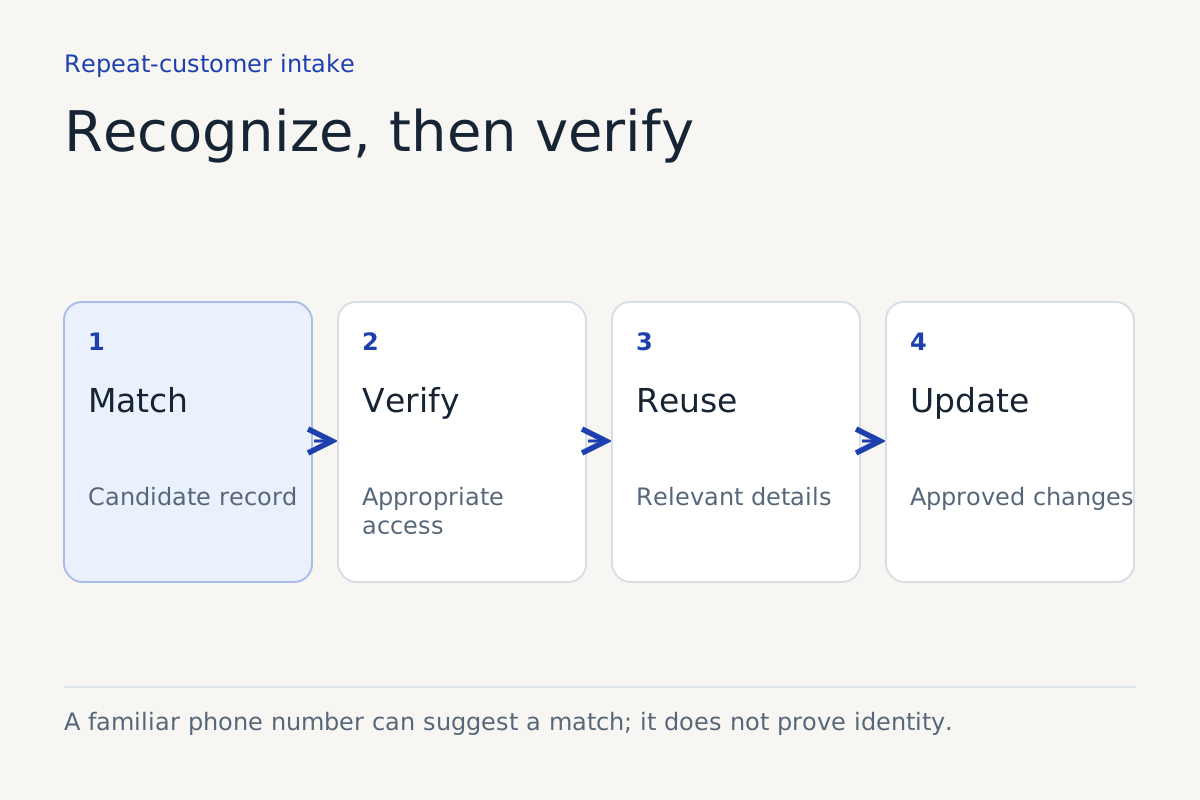
A repeat customer wants convenience: remember the service address, find the previous appointment, and avoid asking the same questions again. The business needs accuracy: do not reveal one person's details to someone else or overwrite the wrong record.
Those goals fit together if record matching and identity verification have separate jobs. Matching finds possible records. Verification establishes whether the caller may access or change the relevant information. A phone number can help with the first job without finishing the second.
For a hypothetical home-service business, the useful design is progressive. Recognize a possible returning customer, perform the verification appropriate to the requested action, and reuse only the information needed for that action. Do not make the customer repeat everything merely because the system cannot distinguish those stages.
Begin with a candidate record
An incoming phone number might match a household, a business reception line, or an old account whose number has changed hands. An email address could belong to an office coordinator acting for several sites. Treat the match as a candidate until the workflow's verification requirements are met.
The assistant can keep the interaction natural without announcing private details. It might ask whether the person is contacting the business about an existing appointment and invite an appropriate reference. It should not begin by reading out a stored address, account balance, or previous service details to an unverified caller.
| Action requested | Matching helps with | Additional decision needed |
|---|---|---|
| General opening hours | Usually nothing | No account access required |
| Find an appointment | Locate candidate records | Verify access to appointment information |
| Change a service address | Identify the relevant account | Verify authority to modify that record |
| Discuss a charge | Locate the possible transaction | Apply the business's access and review rules |
| Book new work | Suggest the appropriate existing record | Confirm details and permissions before reuse |
This is an original design worksheet. Verification methods should be chosen for the actual data, action, and risk, with appropriate security review.
Reuse facts after confirming their relevance
Once the caller is appropriately verified, avoid repeating fields that have not changed. Confirm the details that affect the current task. If the business serves several properties for one customer, ask which site the request concerns instead of assuming the most recently visited location.
A repeat customer may have a new contact preference, a changed address, or a different person authorized to coordinate work. Give the assistant a safe way to record those changes for approval. Do not make it choose between ignoring the update and overwriting the authoritative record immediately.
Distinguish an action-specific correction from a permanent account change. A customer might want a technician to call a temporary onsite contact for tomorrow's visit. That does not necessarily mean the main account phone number should change.
Remembering the right detail helps the customer. Remembering it in the wrong place creates work for the next person.
That original operating principle should guide the data model. Each detail needs a clear scope: this conversation, this appointment, this property, or the whole account.
Handle shared contacts deliberately
Build test cases around shared phone numbers and shared inboxes. Include a household with multiple customers, a business with multiple locations, and an authorized coordinator who contacts the business on behalf of someone else.
The assistant should not merge accounts because the conversation sounds related. Nor should it create a fresh account whenever a shared number produces uncertainty. Provide a review path for ambiguous matches, preserve the candidate references, and let authorized staff resolve the relationship.
If staff merge or correct records, keep an audit trail. A correction should explain which information moved, why, and what downstream appointments or messages were affected. Otherwise the assistant may continue using a stale duplicate after the CRM has been repaired.
Collect less on the second conversation
A returning customer's request can still trigger an intake script that asks for every field. That is often a workflow problem rather than a model problem. The script may not distinguish missing required information from information already confirmed.
Define which fields are needed for each task. If a person is simply asking to change an appointment window, do not collect a fresh account biography. If the current workflow genuinely needs a new detail, explain its purpose in plain language.
Avoid importing irrelevant history into the model's context. A previous complaint, personal circumstance, or internal staff note may have no bearing on the current booking request. Reusing information should be a deliberate permissioned operation, not a blanket instruction to remember everything.
Let the customer correct recognition
The system should recover gracefully when its candidate match is wrong. Give the customer a simple way to say they are contacting the business about a different account, property, or person. The assistant should return to the appropriate verification path without arguing from its stored data.
Preserve uncertainty in staff summaries. “Possible match to account ending 42; caller says different property” is more useful than a confidently attached account that staff later discover is incorrect. Staff need to see what was verified and what remains tentative.
Do not punish a customer for declining to use a recognized channel. A person may prefer to provide a booking reference rather than confirm information through an unfamiliar automated conversation. Offer the business's approved alternative process.
Measure convenience and mistakes together
In a limited pilot, review repeated questions and record-selection errors side by side. Reducing questions is useful only if the system still identifies the correct record and respects the action's access requirements.
Inspect cases with multiple matches, corrected details, and human intervention. Ask whether the staff handoff preserved the original request and avoided unnecessary recollection. A shorter intake is not a success if an employee later spends time repairing the wrong account.
The NIST AI risk management framework supplies a voluntary risk-evaluation context. For this workflow, the practical release condition is specific: the assistant can reuse confirmed details without confusing a candidate match with authorized access.
Keep reading