Risk and accountability
Plan the correction before the AI makes a promise
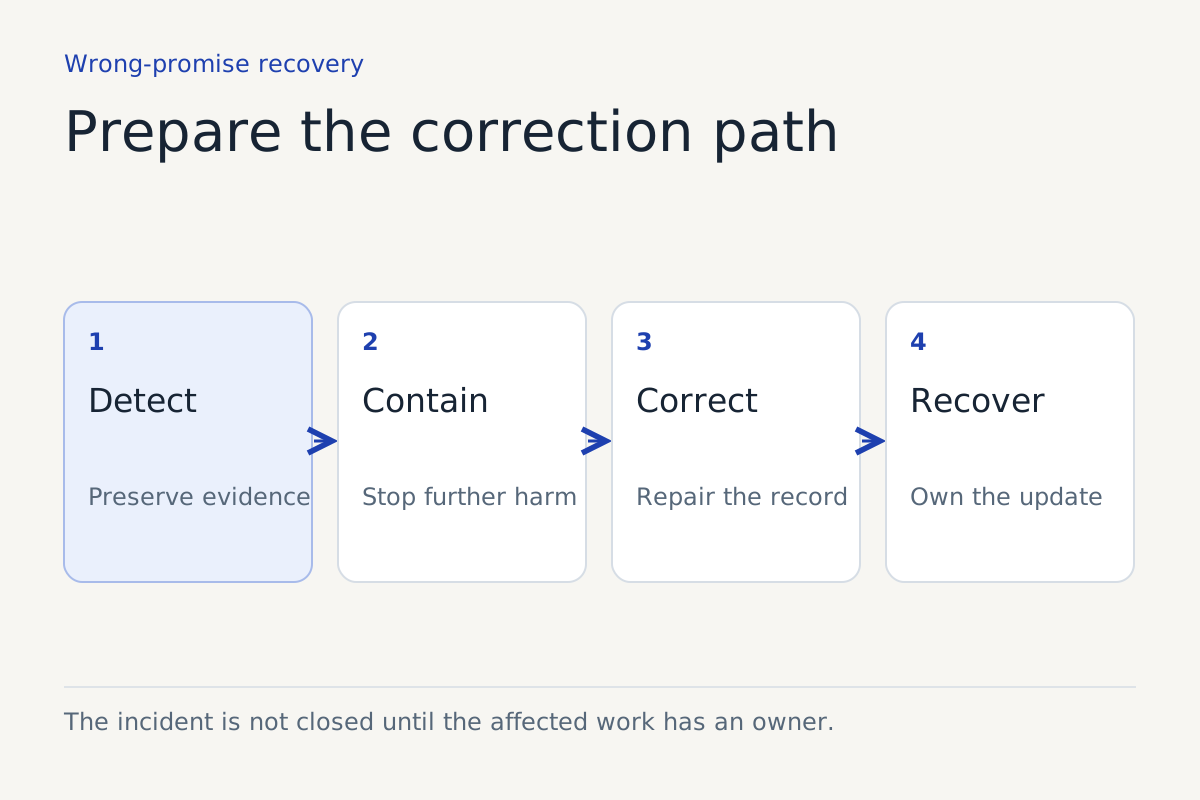
Prepare an incident procedure for wrong commitments that contains the issue, preserves evidence and assigns customer recovery.
Published · Collection dates are retrospective editorial dates.
The assistant tells a customer that an exception has been approved. It has not. Now the business has two problems: a system made an unauthorized commitment, and a person reasonably expects the commitment to be honored.
Changing the assistant's instructions addresses only part of the situation. Someone must contact the customer, reconcile the records, stop related automated actions and decide what recovery the business can authorize. If those responsibilities are undefined, a technical fix can leave the actual harm untouched.
Prepare the correction process while the workflow is being designed. The following is an original incident framework for customer-facing operations, not a legal determination of what remedy any particular promise requires.
Distinguish the claim from the action
First establish what happened. Did the assistant merely say an action was approved? Did it submit an action? Did the downstream system perform it? Did a person later rely on that result?
These differences affect containment and recovery. A false booking confirmation may require contacting the customer. An actual duplicate booking may also require releasing capacity. A mistaken refund promise differs from a payment that already moved.
Preserve the conversation identifier, relevant timestamps, workflow version and external record references. Restrict access to the evidence through the approved process. Do not scatter sensitive excerpts across informal chat channels during the investigation.
| Question | Evidence to inspect | Owner to identify |
|---|---|---|
| What did the customer hear? | Transcript or approved interaction record | Customer recovery lead |
| What did the system attempt? | Action log and request identifier | Technical owner |
| What actually changed? | Downstream record and transaction state | Business-system owner |
| What continues automatically? | Queued reminders or follow-ups | Workflow owner |
| What can be offered now? | Approved policy and exception authority | Authorized decision maker |
The table is an investigation aid. It does not imply that every workflow should store recordings or that every record is available in every system.
Contain the affected capability
Stop the behavior that can repeat the issue. That may mean disabling one action, narrowing the assistant to message-taking or routing the affected task to people. Choose the smallest reliable containment that the accountable owners approve.
Check queued work as well as new conversations. A wrong appointment can still generate reminders after the assistant is paused. A sales sequence can continue repeating an incorrect offer. Containment needs to reach those downstream effects.
Record the change and its operating consequences. If staff receive extra work, tell them what is changing and which customer expectations need particular care. A silent fallback can create a second failure.
Give one person the customer recovery
Choose a role with authority to explain the situation and obtain an approved remedy. Do not send the customer through several queues while each team decides the issue belongs elsewhere.
The recovery contact should distinguish known facts from unresolved investigation. Avoid repeating the assistant's unsupported claim or promising a new outcome before authorization. Use the business's approved communication process and involve legal or other specialist reviewers where the facts require it.
In a hypothetical service business, an assistant promises a next-day visit that the dispatch team cannot provide. The recovery owner needs current capacity, the customer's request and the available approved alternatives. Another automated apology without that information does not finish the work.
Correct the business records carefully
Determine which records are wrong and which are evidence of what occurred. An incorrect appointment status may need correction, while the investigation history should preserve that the error happened through the approved retention process.
Check linked records and notifications. A corrected CRM field does not prove the scheduler, reminder system and staff task all agree. Verify the final state in each relevant system.
For actions that cannot simply be reversed, involve the authorized business owner. Do not invent a reversal mechanism or let the assistant choose a substitute commitment to make the dashboard look complete.
Customer recovery belongs to the same incident as the technical failure.
This is an original editorial principle. It keeps the team's attention on the person affected by the automation rather than only the component that failed.
Find the mechanism before declaring the fix
Was the knowledge wrong? Was the policy ambiguous? Did the assistant use language that overstated a pending decision? Did a tool have broader authority than intended? Did the downstream system accept invalid inputs?
Several causes can coexist. A prompt change may improve the answer while leaving an unauthorized action available. A permission change may prevent the action while leaving misleading wording. Verify the complete expected behavior after the correction.
The NIST AI risk management framework provides a voluntary risk-management context. The customer recovery and reconciliation process here is an original operational application.
Preserve a regression case and a decision record
Turn the failure into an appropriately protected or synthetic test. Include the original customer expectation, allowed action, forbidden commitment and expected downstream state. Run it before restoring the affected capability.
Record what evidence supports restoration and who approved it. List unresolved items with owners. Review whether other customers may have encountered the same mechanism and use the approved process to investigate them.
The incident is ready to close when containment, record correction, customer recovery and prevention have each been checked by their responsible owner. A shorter response is desirable only if it still reaches that outcome. Otherwise, the system has resumed while the business continues to carry its mistakes.
Sources
Explore the workflow considerations for customer messaging support.
Keep reading