Industry guides
Route property enquiries without turning intake into screening
Keep property enquiry routing consistent, reviewable, and separate from judgments about who should qualify.
Published · Collection dates are retrospective editorial dates.
A property enquiry starts with a practical request: a viewing, a question about availability, or a callback. A poorly bounded assistant can quietly turn that request into a judgment about the person asking. It might decide someone sounds unlikely to qualify, infer their circumstances, or steer them toward a different property without an approved reason.
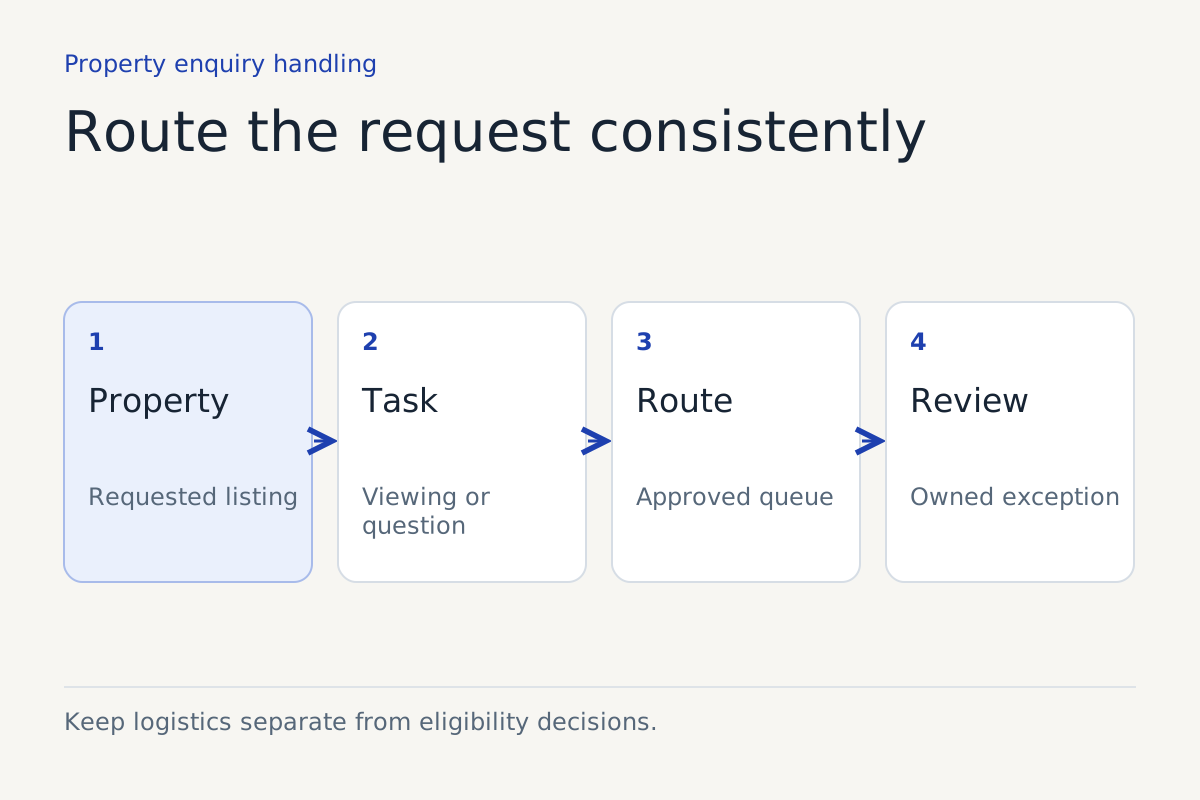
Keep the first workflow smaller. Record the property the person asked about, establish what they want to do next, and route the request through a consistent process. Eligibility decisions belong in a separately reviewed process with defined authority. A conversational interface should not invent that process while it talks.
The framework below is an original operational design. It is for residential enquiry handling, not a legal interpretation or a tenant-screening policy.
Define the routing decision before collecting data
For a hypothetical property management business, the initial routing decision might be: which team should receive this viewing request? The useful inputs are the property reference, requested contact method, preferred viewing times, and whether the person needs help using the booking process.
Ask what each field changes. If a field does not affect the immediate task, remove it from this stage. Gathering extra details because a language model can ask a natural question gives you more sensitive material to govern without necessarily improving the service.
| Intake field | Operational purpose | Boundary |
|---|---|---|
| Property reference | Locate the requested listing | Do not substitute another listing without asking |
| Viewing preference | Find a suitable available time | Use the same booking rules for comparable requests |
| Callback details | Reach the enquirer | Confirm the preferred channel |
| Help using the process | Arrange appropriate assistance | Route to the approved assistance process |
| Free-text message | Preserve the person's actual request | Do not turn incidental details into eligibility scores |
Separate the conversation record from the fields permitted to influence routing. A person may voluntarily mention a family situation, a disability, or where they moved from. The assistant does not need to convert every statement into a structured attribute. Staff reviewing the workflow should be able to explain why the destination queue changed.
Replace “good lead” with an observable task
“Good lead” is too vague to be an intake rule. It invites people to hide subjective judgments inside a score. So are labels such as “serious prospect” or “likely fit” when nobody can identify the evidence and approved decision those labels represent.
Use task descriptions instead: viewing requested, listing question awaiting response, application-process question, existing resident message, or incorrect property reference. Those states tell a team what to do. They do not claim to know the person's suitability.
A routing rule should explain the next piece of work, rather than offer an opinion about the person.
That is an editorial principle, not a quotation from a regulator. Apply it to the interface as well as the internal rules. If the assistant cannot offer the requested viewing time, it should describe the actual availability limitation. It should not imply the person has failed an assessment.
Make equivalent requests travel the same path
Write paired test enquiries. Keep the requested property and appointment preference unchanged, while varying incidental details that should not change the operational answer. Test spelling, accent transcription, language complexity, long messages, and short messages. Include someone who needs staff assistance instead of an online link.
For each pair, compare the available next steps, destination queue, required information, and response timing. Identical wording is unnecessary; consistent access to the approved process is the objective. If one version gets a booking link while the other gets an extra qualification conversation, inspect the rule that caused the difference.
Include unavailable-property cases. An assistant can sound helpful while making unauthorized suggestions about which neighborhood someone should consider. A safer design asks whether the enquirer wants alternatives and uses explicitly stated preferences and reviewed listing information. Record the basis for any suggested alternative so staff can inspect it.
Give uncertain requests somewhere useful to go
Not every message fits a neat category. A person may ask about a policy exception or dispute an earlier response. Do not force those requests through an invented score merely to keep the queue tidy.
Create a review destination with a named owner. Preserve the request in the person's words, the property reference, the answer already given, and the unresolved question. Tell the person what is pending. “Your question has been sent for review” is a different status from “your request has been approved.”
The human process needs a return path. If staff correct a routing decision, record the reason and check whether other enquiries were affected by the same rule. A private correction to one customer leaves the underlying process unchanged.
Treat archived guidance carefully
The HUD May 2024 announcement concerned tenant screening and digital advertising. It is an archived historical announcement, not evidence that every statement it references remains current.
A Federal Register notice published in April 2026 lists the digital-platform advertising guidance among withdrawn documents, with withdrawal effective September 17, 2025. That list does not establish the present status of every tenant-screening document. The GAO property-technology report records earlier removal of screening guidance from HUD's website and HUD's March 2025 explanation that it remained in effect at that time. Neither observation is a complete current legal review.
Accordingly, this article does not use the archived announcement as operative authority. Obtain current, jurisdiction-specific review before implementing eligibility, advertising, or screening policies. The routing recommendations here stand as conservative process design, not as a claim that a particular checklist satisfies housing law.
Review what the system actually does
Once a limited workflow is running, sample requests that were redirected, abandoned, or sent for review. Read the actual messages and inspect the routing trace. A dashboard showing the number of enquiries handled will not reveal whether access to the next step changed without justification.
The NIST AI risk management framework provides a voluntary context for ongoing risk evaluation. For this workflow, make the practical review concrete: who can change a routing rule, who approves new fields, and who can immediately disable a problematic branch?
Begin with a single property enquiry path that staff can explain from start to finish. Expand only when the team can account for both ordinary requests and the cases that needed help.
Keep reading