Risk and accountability
Before you record an AI call, map the consent questions
Prepare a recording review covering locations, notice, consent evidence, alternatives and data handling without relying on a universal script.
Published · Collection dates are retrospective editorial dates.
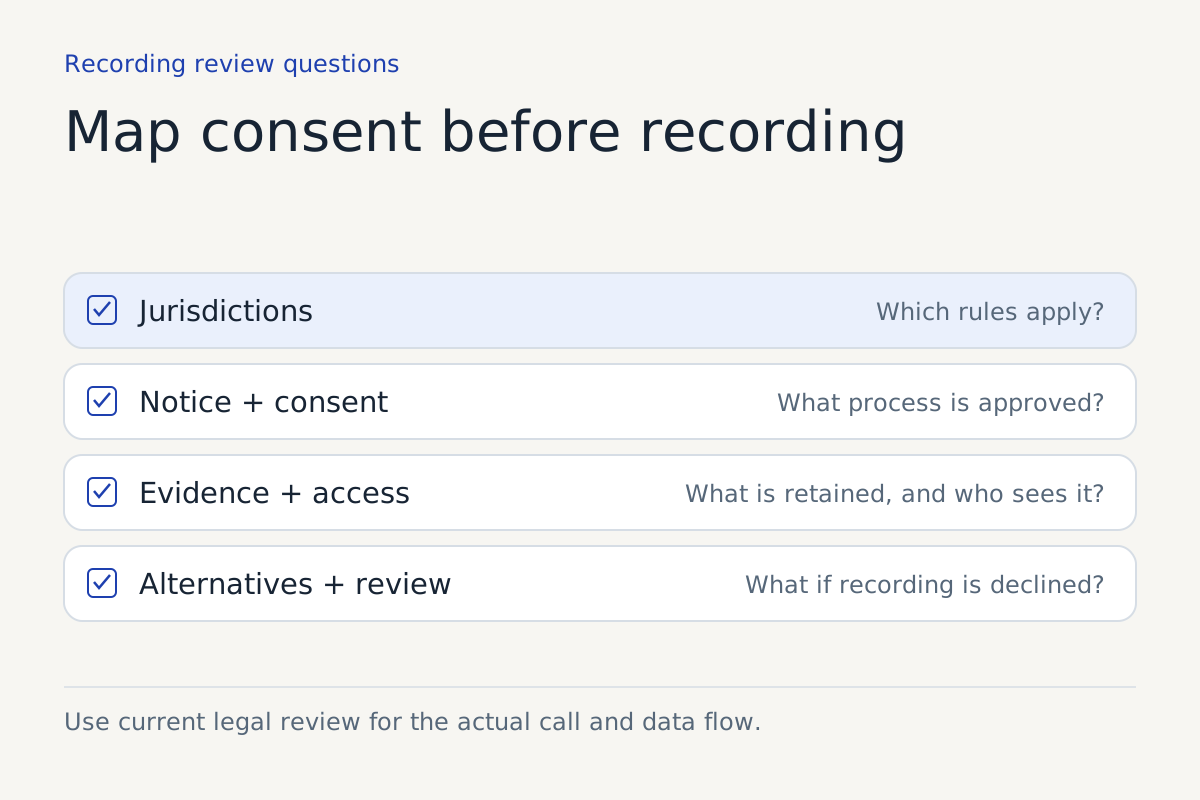
Turning on recording is a configuration choice with consequences far beyond the dashboard. It can create audio, transcripts, summaries, quality-review copies and support access that did not exist in the old phone process. A notice at the beginning of the call does not answer every question about those records.
Before enabling the feature, prepare a concrete workflow for legal and privacy review. The reviewer needs to know who is involved, where the call travels, what is captured and what happens if the caller objects. “We use AI reception” is too vague to evaluate.
This article is an operational issue-spotting worksheet. It does not state the recording law for any jurisdiction or supply a consent script. Current California statutory text could not be independently retrieved from the official legislature site during source verification. Accordingly, no California rule is asserted here. Cross-border and other applicable law need review against current primary authority by qualified counsel.
First ask why the recording is needed
Separate the purposes. Quality review, dispute investigation, staff training, transcription and model improvement are different activities. A feature that is useful for one purpose should not quietly enable the others.
Ask whether the task can be completed with less data. A structured appointment request may be sufficient without indefinite audio storage. That is a design question to evaluate, not a claim that recordings are always unnecessary or that another format avoids legal review.
Write the purpose narrowly enough to test. “Improve service” leaves almost every later use open to interpretation. “Review a limited sample for compliance with the approved booking script” is a more specific proposal for the reviewer to assess.
| Review area | Facts to supply | Decision to obtain |
|---|---|---|
| Participants and locations | Caller, business, staff and processing locations | Applicable requirements and uncertainties |
| Capture behavior | Audio, transcription, summaries and timing | What may be captured and when |
| Notice and response | Exact proposed wording and available choices | Approved notice and consent process |
| Alternative | Non-recorded route and actual staffing | Approved treatment of objections |
| Access and retention | Roles, storage systems and deletion behavior | Approved controls and retention policy |
The table is an original preparation tool, not a list of statutory requirements.
Map the call before writing the notice
Describe the telephone provider, voice application, transcription service, model provider, CRM and review tools involved. Include temporary buffers and diagnostic copies where the provider can identify them. Ask which parties can access content and for which purposes.
Confirm when capture begins. Does the system record the notice itself? Can recording be withheld until the approved condition is met? Does disabling stored audio still permit transcription or temporary processing? These implementation details can materially change the proposal being reviewed.
Do not assume that the word “recording” means the same thing to every vendor. Request written descriptions of storage and processing behavior. Preserve the reviewed configuration so later changes can be compared with it.
Make the caller's choice operational
If the approved process provides a choice, the application needs to implement it reliably. Specify how the choice is recognized, what evidence is recorded and what happens if the response is unclear. Obtain counsel's direction on the appropriate treatment of those cases.
Design the alternative before offering it. A non-recorded route needs actual capacity and an accurate explanation. Sending an objecting caller into a dead end makes the offered choice hollow.
Include transfers and repeated calls in the review. A process approved for one interaction may not answer what happens when additional parties join or the customer contacts a different number.
Treat consent evidence as a record with an owner
Ask counsel what evidence is appropriate for the approved process. The implementation then needs to preserve that evidence with the relevant call identifier, process version and configuration. Avoid relying on a generic checkbox that cannot be connected to the interaction.
Also ask how a disputed or withdrawn preference should be handled. The operational team needs instructions it can execute, including the effect on queued calls, existing records and future contact. Do not improvise that response during a complaint.
The exact decisions depend on the reviewed facts and law. This article deliberately leaves them open rather than making a convenient assumption in software.
Follow the copies after the call ends
Audio may be removed while a transcript, summary or exported file remains. Inventory those copies and identify who controls them. Define access, retention, export and deletion for each approved record type.
The NIST generative AI profile provides broader data-privacy risk context. It is not recording-law authority, and the operational worksheet here does not establish legal compliance.
A reviewed notice is useful only when the actual call behaves as reviewed.
This is an original operating principle. Test the implemented flow against the approved design, including objections, unclear responses, dropped calls and transfers.
Keep an approval record for the configuration
Save the reviewed workflow, responsible approver, applicable scope, unresolved issues and conditions that require another review. Include changes in provider, processing location, data use and call routing among the events the owner should assess.
If the necessary review remains incomplete, leave the affected recording capability disabled or use another specifically approved process. That is a concrete project boundary, not a universal legal conclusion. The point is to give the business a configuration it can explain and support, rather than a script that appears to settle questions nobody actually examined.
Keep reading