Customer experience
A faster answer is only useful if the next step happens
Use public API and refund documentation to separate acknowledgement, completed actions, and verified business outcomes.
Published · Collection dates are retrospective editorial dates.
“The request has been received.” “The appointment has been created.” “The appointment is correct and the customer has been informed.” These sentences describe different achievements. A system can do the first instantly, do the second incorrectly, and never establish the third.
Speed is easy to show in a demo because the conversation is visible. The resulting business state often lives in another system. Evaluate both, and make the customer-facing status precise enough to reflect the difference.
Three public documentation examples help expose the gap. This is a reading of documented mechanisms, not a live test or an audit of Google Calendar, Stripe, or Shopify. The operating recommendations are original interpretations for a buyer's own workflow.
Example one: an event exists
Google Calendar's event-creation guide describes creating an event and returning event information. That gives an integration a record it can inspect. It does not establish that the business intended that particular customer, location, service category, or arrival promise.
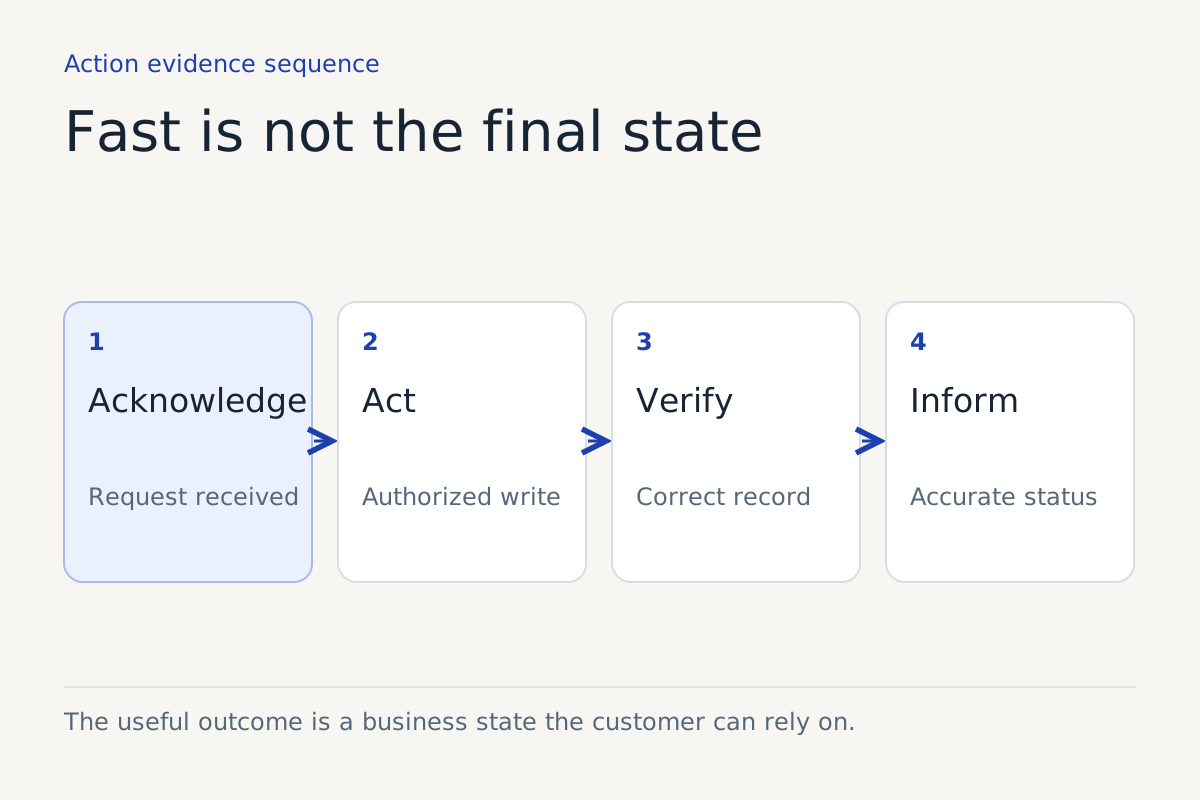
For a hypothetical appointment assistant, divide the work into explicit stages:
- Acknowledge: record the customer's request and identify what remains to be confirmed.
- Validate: check the business's booking rules and the correct customer or site record.
- Act: submit the authorized booking operation.
- Verify: inspect the returned or retrieved record against the intended change.
- Inform: send an accurate confirmation through the agreed channel.
These are proposed workflow stages, not names imposed by the calendar API. A simple operation may complete them quickly, but the implementation still needs evidence for each relevant stage.
An event identifier helps staff trace a booking. The assistant should retain it with the request instead of merely saving a transcript that says “booked.” If the wrong appointment was created, the team needs to locate the record and correct the business state.
Example two: the response is missing
Stripe's explanation of idempotency discusses failures where an operation may succeed even though the client does not receive the response. The lesson for a connected assistant is to distinguish failed delivery of a response from proven failure of the action.
Imagine a hypothetical booking write that times out. The assistant should not immediately say that no booking exists, nor blindly repeat the operation as a new request. It needs a safe reconciliation process based on the connected system's actual behavior.
A customer-facing pending message can be more accurate than a fast success or failure message. Assign an owner to resolve uncertainty, preserve the original request identifier, and avoid inviting the customer to create duplicates while the first action remains unknown.
An uncertain result is a state the workflow must manage, not a pause the assistant should talk its way through.
This is an original design principle. It matters because conversational systems tend to reward an immediate answer, while operations needs a correct and recoverable record.
Example three: the money action has consequences
Shopify's refund documentation states that an admin-initiated refund cannot be cancelled or reversed. A fast refund answer therefore needs correct authority and correct inputs before the operation, rather than a vague expectation that staff can undo any error later.
The documentation also gives a reason to keep distinct commercial states visible. A return, a refund, and the customer's receipt of money are not interchangeable labels. The assistant should describe the state the authoritative system actually reports and avoid promising a timing outcome that the business has not verified.
For a hypothetical store, a customer may ask where their refund is. The useful answer might be that the store initiated the approved action and that a particular status is recorded. That is different from claiming the money is already available in the customer's account.
Write a status vocabulary before launch
Choose words your staff and customers can both interpret. “Requested,” “awaiting approval,” “submitted,” “confirmed,” and “needs review” can be useful if each maps to evidence. The exact words matter less than the agreement behind them.
Avoid using one cheerful completion phrase for everything. If “all set” sometimes means a message was saved and sometimes means a financial action completed, the customer cannot know which promise to rely on.
Keep status changes inspectable. Staff should see who or what changed the state, which action reference supports it, and what remains open. If the state is derived from a model's summary rather than an authoritative result, say so in the operational record and consider whether that is adequate.
Measure elapsed time to the right event
First response time measures acknowledgement. Time to confirmed booking measures a completed task under your definition. Time until an unresolved issue acquires a human owner measures recovery. These intervals can move in different directions.
Do not use the fastest interval to imply that the whole journey improved. A hypothetical assistant might reduce acknowledgement time while increasing the delay before staff notice failed bookings. That would be an important operating failure even if the conversation felt responsive.
Review completed records, pending cases, and customer updates together. If the customer heard confirmation before verification, the status design is wrong even when the action later succeeds.
Ask the demo to show the records
Have the vendor perform a normal request, an unauthorized request, and an operation with an uncertain result. Watch the customer message and inspect the connected record. Ask how staff find and resolve the pending case.
The useful demonstration ends when the business state and customer expectation agree. That is the outcome worth making faster.
Keep reading