Implementation
Give staff a way to correct the system
Turn frontline feedback into assigned fixes, regression tests and visible responses instead of an unattended suggestion box.
Published · Collection dates are retrospective editorial dates.
A receptionist notices that the assistant keeps promising a service the business no longer offers. They tell a colleague, who tells a manager, who mentions it in a meeting. Meanwhile, the next customer hears the same promise.
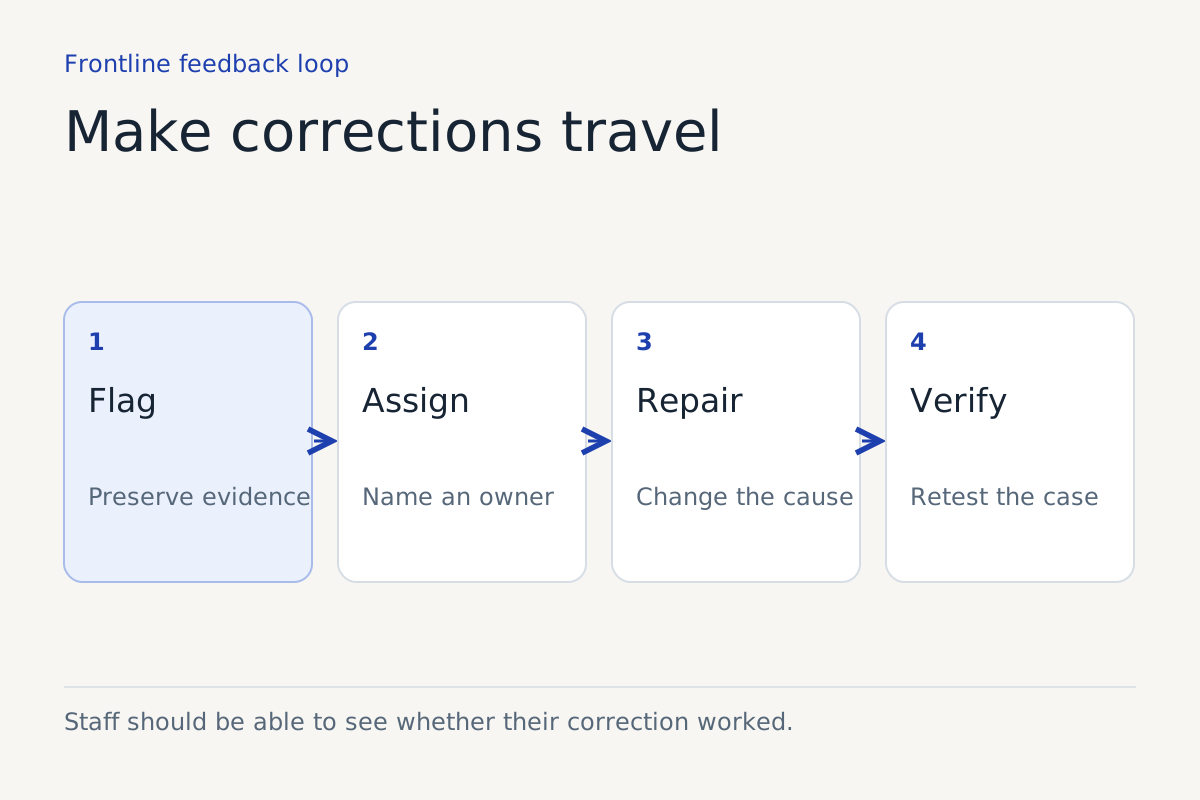
That is a hypothetical example, but it exposes a concrete design problem: noticing an error and correcting the system are separate activities. Staff need a route that joins them. Asking people to “send feedback” without defining ownership simply adds another place where unfinished work can collect.
Build the feedback process alongside the workflow. Frontline employees should know what to report, how to protect customer information, who will respond and what to do while the issue remains unresolved.
Make reporting easier than explaining around the error
Provide a short form or existing ticket type that staff already know how to use. Ask for a conversation or request identifier, the expected behavior, the observed behavior and the immediate consequence. Let people flag uncertainty rather than requiring them to diagnose the technical cause.
A useful report might say, “This customer was told the appointment was confirmed, but the scheduler shows a pending request.” That is more actionable than “the model hallucinated,” because it identifies the observable discrepancy.
Do not ask staff to paste sensitive customer details into a public channel or personal tool. Give them a permitted reference method and access-controlled evidence destination. The reporting route should respect the same data boundaries as the underlying service.
| Report type | What staff can describe | Likely decision owner |
|---|---|---|
| Wrong information | Approved source differs from answer | Knowledge owner |
| Missing policy | Team has no agreed answer | Operations policy owner |
| Failed action | Intended record differs from stored result | Integration owner |
| Poor handoff | Recipient lacks context or ownership | Queue manager |
| Authority concern | Assistant attempted an excluded action | Risk and workflow owner |
These categories are an original starting point. Allow reports that do not fit, then improve the categories from actual use.
Separate correction from blame
People will stop reporting if every issue becomes a debate about whether they used the system properly. Inspect the process and evidence first. Training gaps may exist, but so may misleading interfaces, impossible instructions and missing policy.
Invite reports about the human side too. If staff cannot find the assigned task, do not dismiss that as unrelated to AI. The customer experiences one workflow, including the software and the person who receives it.
The paper Generative AI at work examines assistance in a particular support setting. It does not establish that every frontline team benefits from a new tool. Local feedback and observed work remain necessary.
Decide which reports require immediate action
Distinguish ordinary improvement ideas from errors that need containment. Give staff an approved route for urgent issues and define who can pause the affected capability. Do not rely on a general feedback form for a potentially unauthorized disclosure or wrong business commitment.
The severity definitions should reflect your operation. A confusing phrase and an incorrect cancellation may both deserve correction, but they need different responses. Staff should not need to understand model internals to recognize the difference.
Run that exercise with someone who was not on the implementation team. If they cannot follow the route, simplify it before launch.
Close the loop visibly
Acknowledge the report and explain its disposition: accepted for a fix, awaiting evidence, requiring a policy decision, or outside the current scope with a stated reason. Give the reporter a way to see status without repeatedly asking a manager.
When a change is made, explain what behavior changed and what remains limited. “Fixed” is too vague if staff still need a workaround for some cases. Link to the current approved process rather than relying on a chat announcement that will disappear in the feed.
Recognize useful reports without turning feedback into a competition. The purpose is reliable work, not maximizing ticket counts. A quiet queue can indicate quality, confusion about reporting or a team that has stopped expecting a response.
Turn failures into tests
Preserve a suitably de-identified or synthetic version of the failed scenario. Define the expected result, reproduce the failure where practical, and verify the proposed correction. Include the case in future regression checks.
Do not fix one sentence while ignoring the mechanism. If the answer came from an obsolete document, remove or supersede the source. If the tool granted excessive authority, changing the prompt alone may leave the same action available.
A correction is complete when the next person can rely on the changed process.
This is an original editorial principle. It includes the system behavior, staff instructions and customer recovery where applicable.
Teach staff the boundaries, not the technology lecture
Training should cover what the assistant handles, what it cannot decide, how to inspect a pending action and how to take over. Use realistic scenarios with corrections, incomplete details and unavailable recipients. Let staff practice the recovery steps in the actual interface.
Keep a short current reference near the work. Update it when ownership or capability changes. Give new employees the same access to the process rather than assuming informal knowledge will reach them.
At the next review, inspect a few reports from submission to outcome. Look for delays between recognition, assignment and verification. Improving that path can make the operation more reliable long after the first set of AI instructions has become outdated.
Sources
Explore the workflow considerations for customer messaging support.
Keep reading