Implementation
Launch small enough to learn from every failure
Choose a first release whose coverage, review workload and rollback can be handled by the people operating it.
Published · Collection dates are retrospective editorial dates.
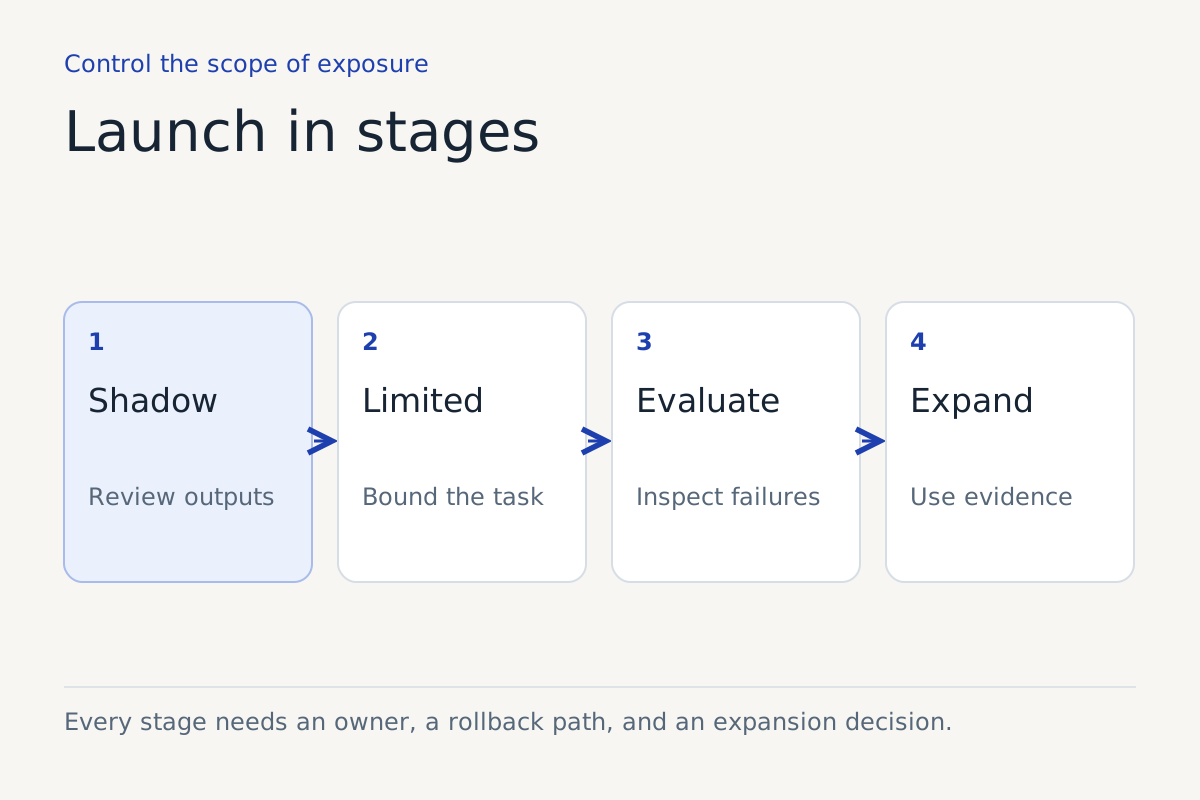
A first release should be small enough that your team can inspect what happened and correct it. “Small” does not mean a particular number of users. It means the volume, task variety and consequences fit the review capacity you actually have.
If a new workflow generates more unresolved exceptions than staff can examine, the pilot has already outgrown its operating model. Expanding it because the assistant sounds capable only increases the distance between what you believe is happening and what you can verify.
The release design below is an original checklist for that decision.
Pick one boundary customers can understand
Limit the first release by a coherent task, channel, location or coverage period. “Take routine service requests for one branch” is easier to operate than “handle simple requests,” because simplicity can mean different things to different people.
Write the included work and the excluded work side by side. Specify which external actions are allowed. State how customers reach a person when their request falls outside the release. Ask a frontline employee to classify sample requests without consulting the project lead.
Basecamp's scope-boundary method is useful inspiration for making exclusions explicit. It is a product-scoping method, not evidence that any particular AI release size is safe.
| Release question | A usable answer | A weak answer |
|---|---|---|
| What is included? | Routine booking requests for one approved service | Easy calls |
| What can it change? | Create a request for human confirmation | Whatever the integration supports |
| Who reviews it? | Named coordinator with scheduled review time | The team |
| When does it pause? | Defined unauthorized action or review backlog | If people complain |
| How do we revert? | Tested route to existing reception process | Disable something in the dashboard |
These are hypothetical examples. The actual thresholds and operating roles must come from your business.
Watch without acting before granting authority
Where practical, run the proposed workflow in a non-customer-facing review mode. Compare suggested answers and actions with what staff would do. Use appropriately authorized or synthetic data and avoid silently copying sensitive conversations into a new service.
This exercise can reveal missing policy, ambiguous fields and incorrect assumptions about staff work. It cannot prove that customers will behave identically once the system speaks to them. Treat it as one source of evidence, followed by a bounded live release.
A request that looks routine in a transcript may become complicated when a caller interrupts, changes a detail or asks for a person. Include those variations in the test set before deciding the review mode has passed.
Budget the review work
Estimate review time explicitly. Choose a sample method and account for investigating failures, contacting customers and updating the test set. A pilot with low software usage can still demand substantial operational attention.
Use reader-supplied inputs: expected interactions, review minutes per interaction, time reserved for exceptions and staff hours available. Label the result as an estimate. If the estimate exceeds the available time, reduce the initial scope or add review capacity before launch.
Rehearse rollback while everything works
The rollback needs to restore a working customer route. Test the phone routing, inbox destination, permissions and customer messages that will apply after it. Confirm who can invoke the change and how they know it completed.
Include work already in progress. Disabling new automated conversations does not resolve pending bookings or queued follow-ups. Those need an owner and a reconciliation procedure. Preserve enough evidence to investigate the failure without leaving unnecessary access active.
Tell staff what rollback means for them. If reception suddenly receives more calls, coverage must exist. A technically successful switch can still fail the business if nobody is ready to receive the work.
Treat a pause as a decision, not an embarrassment
Pre-agreed pause conditions help the team act without arguing about the project in the middle of a failure. Unauthorized access, incorrect commitments and unavailable escalation coverage may justify stopping an affected capability. The exact conditions depend on the task and the risk assessment.
Other problems may permit a narrower operating mode. For example, a hypothetical assistant with unreliable booking creation might continue taking requests while people confirm appointments. That decision needs clear customer wording and actual staffing, not an invisible downgrade.
Expansion should follow evidence the receiving team can inspect.
This is an original operating principle. A collection of positive comments or a clean demonstration does not answer whether the live exception queue is manageable.
Expand one dimension at a time
Once the first scope behaves acceptably, choose the next change deliberately. Add a task, location or coverage period, then update the tests, ownership and capacity estimate. Avoid changing several boundaries while treating the old pilot evidence as unchanged.
Document why expansion is justified and what remains unresolved. Include the costs and customer recovery work, not just successful automated interactions. A useful decision record lets the next manager understand what the team learned without recreating the entire project.
The pilot has earned a broader release when its operating responsibilities are understood and supportable. That may happen quickly, slowly, or never for a particular task. Keeping the boundary small until then is a practical way to protect the quality of the work.
Keep reading