Customer experience
Read customer-service surveys before borrowing their headlines
Compare survey populations, dates, definitions, and limits before using industry research to justify a local AI decision.
Published · Collection dates are retrospective editorial dates.
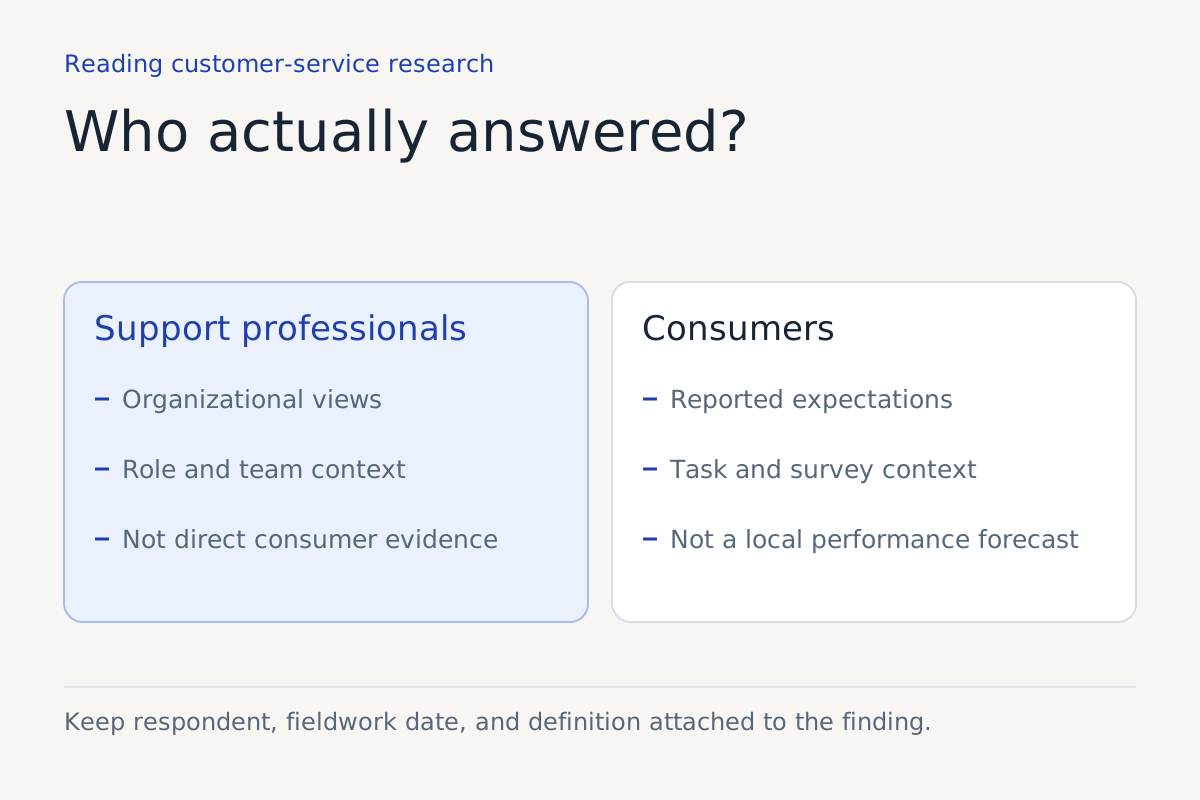
A headline about AI in customer service can travel a long way from the question that produced it. A manager's expectation becomes a claim about customer preference. A global survey becomes a forecast for one practice. A report named for next year becomes evidence of behavior measured this year.
Useful research survives those distinctions. The goal is not to dismiss vendor reports. It is to make sure the evidence answers the question being used to justify a decision.
Consider two public sources: Intercom's 2026 Customer Service Transformation Report landing page and Zendesk's 2026 CX Trends release. Both are useful industry context. Their populations and published methods should prevent them from being treated as interchangeable evidence.
Begin with the respondent
Intercom's public report page describes respondents as customer support professionals and provides role, region, and team-size breakdowns. Its professional population matters when interpreting statements about organizational priorities or reported performance. Those are not automatically direct statements from consumers.
Zendesk's release describes separate consumer and business surveys. Its methodology says they were conducted in June 2025, although the report is branded for 2026. The release also distinguishes business respondent roles. Read each claim with its respondent group attached.
| Reading question | Intercom public page | Zendesk public release |
|---|---|---|
| Who is described? | Customer support professionals | Separate consumer and business populations |
| What context is visible? | Role, region, team size, and industries | Survey period, country coverage, and respondent groups |
| What should remain separate? | Professional perceptions and customer behavior | Consumer answers and business answers |
| What is still needed for a detailed claim? | Exact question, denominator, and methods | Exact question and the relevant group's results |
This comparison uses only the accessible public material. It does not imply a full audit of either report or reproduce every claim in the downloadable editions.
Keep four dates apart
A report can have a fieldwork date, a publication date, a branded year, and a date on which you accessed it. Those dates answer different questions.
Fieldwork tells you when respondents answered. Publication tells you when the publisher released the analysis. The branded year helps position the report, but it does not change when the data was collected. Access time tells your reviewer which public page you examined, especially if the page later changes.
In a proposal, name the fieldwork period where it is available. If it is not visible, mark it as a limitation rather than borrowing the report year as a substitute. A claim about current customer expectations needs more care than a broad observation about how organizations were thinking during a prior survey period.
Inspect what the question could measure
A respondent can report a belief, a recollection, an intention, or an observed business result. Those are different forms of evidence. “We expect to invest” does not establish that the investment happened. “Customers want faster support” said by managers does not directly measure customers' willingness to use a particular automated service.
Before adopting a number, find the exact question and answer options. Check whether the respondent was asked to choose one priority, select several, or rate agreement with a statement. Ask which subgroup the denominator refers to and whether the public summary preserves that distinction.
If those details are unavailable, use the finding as directional context with a clear limit. Do not turn a prominent percentage into a financial-model assumption simply because it is easy to cite.
Do not pool incompatible results
Two reports may use the same word differently. “Resolution” could be a customer's judgment, a helpdesk status, or a vendor's billing definition. “AI adoption” could include staff assistance, customer-facing automation, or experimentation.
A comparison that averages unlike definitions creates a new number with no defensible meaning. Keep results in their original context. If you want a shared metric for your own pilot, define it separately and measure it locally.
The same caution applies to industries and geography. A support organization with a large digital product customer base can supply useful questions for a small appointment-based business. Its responses do not become a measured forecast of that business's callers.
Translate the research into a testable question
Imagine a hypothetical owner reading a report about personalization. The useful next step is to ask what missing context causes repeat work in their own operation. Perhaps customers repeat an appointment reference across channels. Perhaps staff cannot see whether an earlier callback occurred.
That observation can become a pilot question: does preserving verified appointment context reduce repetition without increasing record-access errors? The research helped identify a topic. The local pilot supplies the evidence for the operating decision.
Write the distinction explicitly in the proposal. “Industry research suggests this issue deserves attention” is a different statement from “our customers will achieve this outcome.” A skeptical finance or operations reviewer should be able to trace which inputs came from the business and which merely prompted investigation.
Build a citation card before using the finding
For any consequential claim, keep a short evidence card with the source, publication date, fieldwork period if known, respondent group, exact measure, and the decision it informs. Add a line describing what the source cannot establish.
This small discipline also makes future updates easier. A reviewer can replace a report edition without silently carrying forward definitions or populations that changed.
Ask for local evidence at the approval meeting
A vendor report can make a problem visible and supply useful vocabulary. It should not carry the full burden of an implementation decision. Bring a sample of your own contacts, a defined workflow, a baseline, and a plan for observing failures.
When a headline sounds persuasive, preserve the useful question and reduce the claimed certainty. That approach respects the research and gives the business a stronger reason to act: evidence tied to its own work, with assumptions visible enough to challenge.
Keep reading