Operations
Time saved does not automatically become money saved
Build an AI business case that separates released capacity, avoided spending, incremental contribution, and ongoing review costs.
Published · Collection dates are retrospective editorial dates.
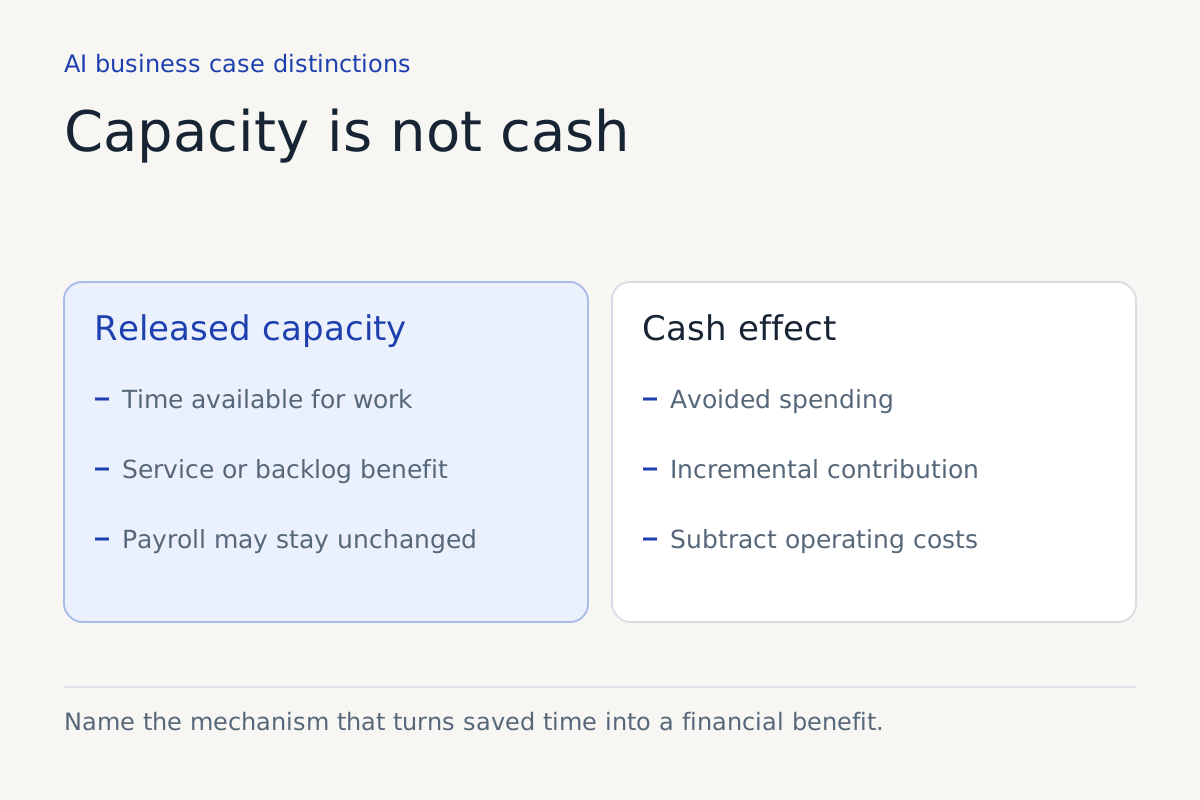
A staff member spends less time on a task. The business multiplies the minutes by an hourly rate and calls the result savings. The arithmetic is simple; the financial claim may be wrong.
If payroll, overtime, contractor bills, and revenue all remain unchanged, the immediate effect is released capacity. That capacity may be valuable. It could improve service, reduce a backlog, or let staff handle more work. But it becomes a cash benefit only through a mechanism the business can identify and observe.
A credible AI business case separates those mechanisms. It also counts the work the new system creates: review, exceptions, corrections, maintenance, and management attention.
Use evidence for the task you are changing
The academic paper Generative AI at work studies AI assistance in a particular customer-support setting. Its setting and design matter. A result from staff assistance does not automatically establish the economics of an autonomous phone system at another business.
Use external research to inform questions and possible mechanisms. Build the local financial model from the actual task, current staffing arrangements, and observed pilot effort. Do not paste a published productivity figure into your revenue forecast as if it were a measured local result.
Work through a hypothetical monthly model
The following figures are deliberately invented to demonstrate the calculation. They are not market benchmarks, vendor prices, or Kingstone results. Replace each with your own evidence or explicitly labeled assumption.
Suppose a hypothetical operation processes 600 suitable requests in a month. Handling each currently takes an estimated six staff minutes. The proposed assistant is expected to remove four minutes from each request, while staff retain two minutes of review or related work.
Gross released time is 600 × 4 minutes = 2,400 minutes, or 40 hours. The pilot then identifies eight additional hours of exception handling and system maintenance. Net released capacity is therefore 32 hours for that month.
| Hypothetical input | Calculation | Meaning |
|---|---|---|
| Suitable requests | 600 | Only the tasks inside the defined scope |
| Gross time released | 600 × 4 ÷ 60 = 40 hours | Before new support work |
| New exception and maintenance effort | 8 hours | Observed or estimated separately |
| Net capacity released | 40 − 8 = 32 hours | Available for a defined use |
| Illustrative loaded hourly value | $30 | A valuation assumption, not cash savings |
| Capacity valuation | 32 × $30 = $960 | An estimated value of time |
The $960 is not automatically money the business keeps. If the same employees work the same paid hours, the cash cost has not fallen merely because the time can be used differently.
Identify the conversion mechanism
There are several possible paths from released capacity to a business benefit. They need separate evidence.
Avoided spending. The business may reduce paid overtime, contractor hours, or another variable expense. Confirm that the released time occurs in the same periods and roles where that expense can actually be avoided. Thirty minutes spread across many shifts may not eliminate a paid shift.
Incremental contribution. Staff may use the capacity to complete additional work. Estimate contribution after the variable costs of delivering that work, rather than counting all additional revenue as profit. Establish that demand exists and that another constraint does not prevent delivery.
Service improvement. Staff may spend more time on difficult cases or reduce a backlog. That can be worthwhile without an immediate cash claim. Define the operating benefit and the evidence that would justify continued funding.
Compare two hypothetical uses
Return to the illustrative 32 hours. In one scenario, eight hours replace overtime that would otherwise cost $45 per hour. Avoided spending is 8 × $45 = $360. The remaining 24 hours stay available for other work.
In another scenario, the team uses some capacity to complete 12 additional jobs, each with an assumed $70 contribution after variable costs. Incremental contribution is 12 × $70 = $840. That estimate needs evidence that those jobs are additional and feasible.
Do not automatically add $960 to either scenario. It values the same released capacity. If the business combines overtime reduction and additional jobs, allocate the hours explicitly and show that the uses fit together.
The following simple comparison illustrates why the distinction matters:
| Hypothetical benefit claim | Amount | Evidence required |
|---|---|---|
| Capacity valuation | $960 | Reliable time estimate and usable hours |
| Avoided overtime scenario | $360 | Overtime spending actually avoided |
| Additional-jobs scenario | $840 | Incremental completed jobs and contribution |
These rows are alternative lenses, not a total to be summed.
Subtract the system's operating cost
Include software and usage charges, integration maintenance, review time, correction work, training, and the cost of running the fallback process. Some costs are one-time setup; others recur. Keep them separate so the monthly view does not disguise the initial investment.
For illustration, if a hypothetical system costs $500 per month before staff effort, the $360 overtime scenario produces a negative monthly cash effect of $140 before any other costs. The $840 additional-jobs scenario leaves $340 before remaining costs and uncertainty. Neither calculation proves the project is good or bad; each exposes what must be true for the decision to work.
If maintenance effort was already deducted when calculating net released capacity, do not subtract that same labor again in the same benefit calculation. Explain the accounting treatment so a reviewer can follow it.
Put uncertainty where it belongs
Use a range for volume, time released, exception effort, and incremental work. Keep verified observations separate from assumptions. A busy month should not become the permanent baseline without explanation.
Set a funding decision tied to evidence. The pilot might continue if a defined task completes reliably and the review burden stays within an agreed limit. Expansion might require proof of avoided expense or additional contribution. Service benefits may justify funding on their own, but should be named honestly.
The strongest business case lets a reviewer disagree with an input without losing the logic. It shows where time goes, what turns into money, and what remains a useful operational improvement whose financial value has not yet been demonstrated.
Keep reading